Tuesday, 2 February 2021

Birch Toppling

Silver birches

Our section of Southampton Common had been used as a training ground and assembly area prior to D-Day and it comprised of open heathland with bracken, gorse and broom that was being invaded by young birches. Fires were frequent and so it remained basically a heath with no large trees except along the roadside. That’s where we would go birch toppling. 

I suppose at this point I should make a Health and Safety Statement. Tree climbing is a risky business and you will fall out of a tree at some point if you do it on a daily basis. If, like me, you are over 70 years old, I’d say it’s time to stop. Having said that, climbing the same tree over and over again in the company of someone like my younger brother (who is brilliant it) gets less risky as your skills improve. We would practice jumping from a couple of meters up, learning to roll like parachutists. 

Young birches tend to grow in drifts downwind of the parent trees. The seeds are tiny but they can overtake a few acres very quickly. A lot of the trees will be the same age. We found a young birch-wood in a tussocky swamp that had avoided any recent fires. The trees were about 8 metres high but very thin. The game we invented was to climb as high as possible, grip the trunk firmly and then get it to swing by throwing your weight back and forth. Eventually, if you were lucky, the tree would bend over and bring you gently to the ground, or perhaps nearly to the ground. If you were unlucky the trunk would snap off or split somewhere below your feet and your descent would be governed entirely by Newton's law of gravity. That’s to say, you accelerated towards the spider-filled tussock grass below, possibly still holding a length of tree.

Apart from the obvious hazards, the thing against arch toppling is the damage it does to the trees. Even the ones that were not broken had trouble straightening themselves. Looking at the destruction we caused we felt ashamed and moved on to dam up the stream instead creating yr own beaver ponds. I have seen similar damage in Maine and in Scotland where rain has frozen on impact and formed a heavy burden of ice in the branches. Almost every birch in a forest can lose its top in this way during one night of freak weather. The weight of ice also brings down power cables and phone lines. 


Robert Frost's house in the woods of New Hampshire

I was reminiscing about this with my wife and she said "Oh Yes, there's a poem about it. I think it's by Robert Frost." And so there is! It's simply called "Birches".

"When I see birches bend to left and right

Across the lines of straighter darker trees,

I like to think some boy's been swinging them.

But swinging doesn't bend them down to stay

As ice-storms do. Often you must have seen them

Loaded with ice a sunny winter morning

After a rain. They click upon themselves

As the breeze rises, and turn many-colored

As the stir cracks and crazes their enamel.

Soon the sun's warmth makes them shed crystal shells

Shattering and avalanching on the snow-crust—

Such heaps of broken glass to sweep away

You'd think the inner dome of heaven had fallen.

They are dragged to the withered bracken by the load,

And they seem not to break; though once they are bowed

So low for long, they never right themselves:

You may see their trunks arching in the woods

Years afterwards, trailing their leaves on the ground

Like girls on hands and knees that throw their hair

Before them over their heads to dry in the sun.

But I was going to say when Truth broke in

With all her matter-of-fact about the ice-storm

I should prefer to have some boy bend them

As he went out and in to fetch the cows—

Some boy too far from town to learn baseball,

Whose only play was what he found himself,

Summer or winter, and could play alone.

One by one he subdued his father's trees

By riding them down over and over again

Until he took the stiffness out of them,

And not one but hung limp, not one was left

For him to conquer. He learned all there was

To learn about not launching out too soon

And so not carrying the tree away

Clear to the ground. He always kept his poise

To the top branches, climbing carefully

With the same pains you use to fill a cup

Up to the brim, and even above the brim.

Then he flung outward, feet first, with a swish,

Kicking his way down through the air to the ground.

So was I once myself a swinger of birches.

And so I dream of going back to be.

It's when I'm weary of considerations,

And life is too much like a pathless wood

Where your face burns and tickles with the cobwebs

Broken across it, and one eye is weeping

From a twig's having lashed across it open.

I'd like to get away from earth awhile

And then come back to it and begin over.

May no fate willfully misunderstand me

And half grant what I wish and snatch me away

Not to return. Earth's the right place for love:

I don't know where it's likely to go better.

I'd like to go by climbing a birch tree,

And climb black branches up a snow-white trunk

Toward heaven, till the tree could bear no more,

But dipped its top and set me down again.

That would be good both going and coming back.

One could do worse than be a swinger of birches."

Front view of Robert Frost's home.

We have been to his wooden house in New Hampshire and it's still surrounded by mixed woods with a lot of birch.

Lambs' tails

Lambs’ tails.

1955: My first school was in Sutton Scotney near Winchester. We only lived there for a year or so and I wouldn’t recognise the place today. Can you believe that the classroom wall had a Victorian alphabet frieze all the way round and that we copied the letters onto slates with white chalks? A bulky woman teacher with weight-lifter’s arms patrolled the isles between our desks while holding a wet rag to wipe away our offerings. If we did a god job, then we moved on to the next letter; if not, we did the same letter again. I probably only reached “d for dunce” before we left. The slates were also good for rolling plasticine on, which I was good at. The only good thing about the school was that it backed onto a railway that mostly carried goods such as water-cress from the chalk-beds by the River Dever. We would all run to the window or the back fence to wave at the steam trains.

More vividly, I remember my walks to school along a narrow lane lined with hedges that were bursting with blossom while being serenaded with bird song. That’s when I learned about pussy willow and lambs’ tails from my mum. They are ingrained in me as the totems of early spring when most flowers and most insects have not yet emerged. Both trees mostly have to rely in the wind for pollination, though early bumblebees will visit the willows. 


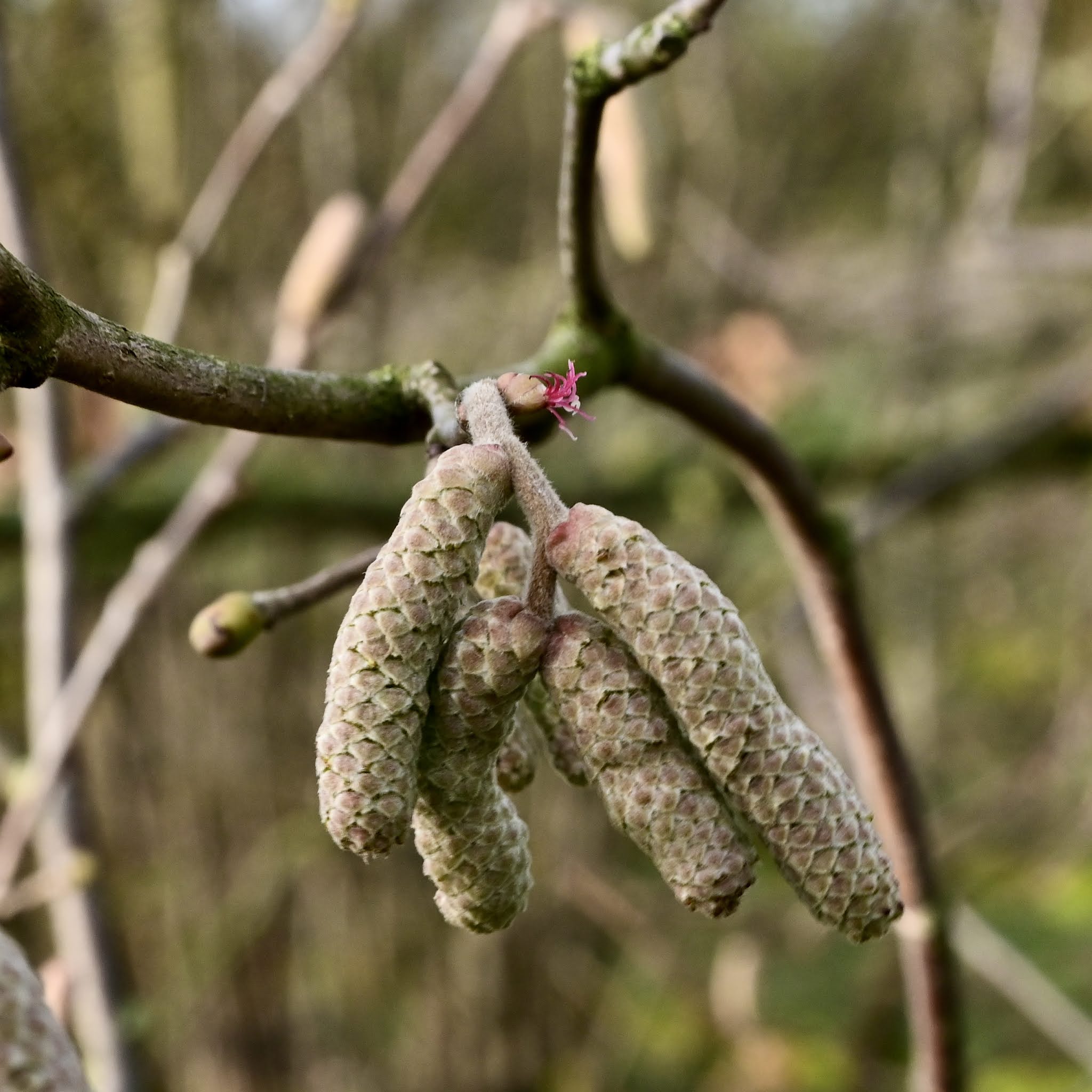
Except when living abroad, I can’t remember a spring when I didn’t celebrate the appearance of lamb’s tails. They seem to come earlier every year. In January 2021 the first male catkins had been out since Christmas but the tiny red female flowers were not to be found. If they get too far out of sync there will be no hazel nuts.

Yellow lambs’ tails are the male catkins of hazel trees. You find them wiggling in the breeze just like their namesakes waggle their tails when suckling from the ewes. Of course, it’s lambing time now, at least in the south, so the name is even more apt. 

Come with me now and take a closer look. Bring the children along too, and a bag or sandwich box to store ant treasures we find.

The dancing movement and the colour of the catkins attracts our attention and I go for a closer look, cradling a catkin in my hand where I can see the pollen. It leaves a dusty yellow smudge on my wrinkled palm. If we cut a few twigs to take home we can put them in a jam jar of water on the window sill. The little red female flower (more of a bud really) isn’t out yet but it will emerge indoors and, quite soon afterwards, fresh wrinkled green leaves will emerge. But we’r not finished looking and it’s not time to go home yet. 

The second hazel ritual that we perform is to scrabble around among the hazel roots where we can find a treasure-trove of snails’-shells, seeds, woodlice, ladybirds and broken hazel nuts from the previous season. We can handle and admire the living things carefully and release them but we can keep the shells of the nuts and of the snails for later. I like to arrange them on pieces of card and glue them down, making patterns and collages. Each card is a keep-sake, like a diary page of a special day, so I write the date on it. 

At this time of year there may be snowdrops, aconites, primroses and crocuses in flower while the shoots of bluebells might be pushing upward, so we should avoid treading on them. Probably, here in the village, all of those flowers will have spread from garden plants, but there is at least one special wild plant that grows only on the roots of hazel trees. Toothwort is a parasitic plant, like broomrape. It has no green parts to make chlorophyll and takes all its nutrients fro the hazel. I have only found it growing in lime rich areas.

When I was a young teacher on Salisbury Plain we took my class on a week-long springtime stay at Oxenwood Field Centre. It rained and blew a gale every day so we made short forays along the lanes and footpaths collecting material to build our own replica of a hedge indoors. We identified all the woody species in the hedge, collected their twigs and made prints with the leaves; we worked out the age of the hedge by the number of species in a 30 yard length and we painted violets and primroses and twined ivy and honeysuckle around the twigs that we had stood in pails of water in front of our painted frieze.  If you have children or grandchildren this kind of session is an ideal home education experience that includes a healthy field trip, a bit of exploring and some material to work on at home.

The nutshells are the best treasure of all. Some are split in half by squirrels, some cracked roughly by nuthatches and others gnawed by mice. In Brampton Wood you can find shells that have been nibbled by hazel dormice. Dormice make a neat hole in the shell like mice do, but without any teethmarks on the outside of the shell. (You can find an identification sheet on-line. Try the UK Safari site.)

Although hazel is a native tree, it is very hard to find one that has been allowed to grow to its full majesty. They are either part of a hedge or they are coppiced to produce bean-poles, pea-sticks, walking sticks, charcoal and even firewood. Coppice used to be the main habitat for nightingales in the UK but now they seem to prefer scrubland. As well as in Brampton Wood you can find hazel coppice in Hinchingbrooke Country Park and Paxton Pits Nature Reserve. The long straight wands grow very quickly as long as the muntjac don’t get to them. Flexible two to three year old stems are used to bind in the tops of laid hedges while ash poles are used for the uprights. 

After the Paxton volunteers showed me how to lay a hedge in the Northampton style I tried making my own version at home, planting hazel, field maple, spindle and a few blackthorns. The hazel took off, leaving all the others standing in their shade. I should have planted the thorns first, or in greater quantity. Still, lots of hazel should mean lots of useful sticks and piles of nuts. Unfortunately, there’s a grey squirrel who thought the same thing. He only comes when the nuts are on the trees and he eats them when they are still green, or he buries them in the garden where they spring up as fresh hazel-whips. 

Like the oak and  the rowan tree, hazel has had a close, traceable association with people for 6000 years. Piles of burned shells have been found in early settlements, proving that the nuts were a very important food item, but it goes deeper than that. One tradition is to name your nut after someone who you might marry. The way the shell burns on the fire is an indication of how things might pan out. Will it smoulder? Will it flare brightly? Will it crackle and jump?

The wood is magical too: think of Moses’ or Gandalf’s staff or Harry’s wand. All those walking sticks and staffs look so special, especially the ones that have a twisty spiral caused by strangling honeysuckle vines. Hazel rods are used for dowsing and water divining. 

When Christianity took hold in England pagan ceremonies, festivals and games were too hard to suppress so the Church took them on board. Annual hazel nut gathering days were unruly affairs, like May Day when folk could go into the woods and get up to mischief. A bishop called Philibert was chosen to be the patron saint of hazel nuts and no doubt the annual nutting day now incorporated a lengthy sermon in the church. 

Today it is almost impossible to find a crop of hazel nuts in England due to the grey squirrels so we import a lot of nuts are imported and they may be cob nuts or filberts (Philiberts) which are cultivated strains. 

(To find out more about London’s hazel trees (and a lot more) read “Ghost Trees” by Bob Gilbert.)


Sunday, 31 January 2021

Sequoia

In front of the local garden centre there’s a tree you just can’t miss. As Giant Redwoods go ours is a dwarf but it is still pretty spectacular. It would have been much taller by now but it was struck by lightning in 1994 and lost its top. One of the lateral branches “turned north” and took on the job but it has left our tree with an obvious kink in the trunk. I imagined the tree was struck down because it had the temerity to be taller than the church tower, but there is a Sequoia in the churchyard that is taller.  

Of course, redwoods are not native to Europe but were imported from California where there is now a Sequoia National Park that is home to some of the most spectacular and largest living organisms on our planet. They are not considered to be the oldest trees in the world but, when you consider that many of them are clones growing from the roots of their ancestors, perhaps they could be. They can be three thousand years old, 80 metres tall and almost 8 meters across the trunk. 


Driving around the countryside here in the UK you may spot a few more Sequoias. They always seem to be in the grounds of manor houses and stately homes and owning one must have been quite a status symbol among the landed gentry. No doubt the Brampton redwood was part of Olivia Bernard-Sparrow’s estate. The National Trust has quite a few redwoods on its properties and I turned to them to get more information about how the trees first came to Britain. 

The crooked redwood 

In 1852 a man called William Lobb caught wind of the giant trees when in San Francisco and rushed to the Sierras to see them for himself. He immediately recognised the potential commercial value of the tree back in Britain and collected seeds, shoots and cuttings to be cultivated at home. The first baby Redwoods arrived here in 1853. At that point the tree had no official scientific name and a transatlantic squabble arose with the English wanting to call it “Wellingtonia” after the battling Duke while the Americans wanted it to be called “Washingtonia” after their first president. In the end science prevailed, placing the giants along with the coastal redwoods in the Sequoia family. 

Fortunately for the trees’ survival, the timber is too brittle to be of much use in joinery or ship building and so the value lies purely in their magnificence. If you want to experience the wonder of a redwood grove, Anglesey Abbey has some fine ones and the Quaker John Dollin-Bassett planted a grove in Leighton Linslade in the Ouzel Valley (Beds) where redwoods still dominate the skyline today. 

If you meet the tree up close, go and give it a hug. It will take several people holding hands to measure its girth. The largest ones can be 24 meters round. In the process you might notice that the bark is thick, soft and warm, even a bit spongy. My wife, who is American, tells me that another name for redwoods is “punch-bark”. Go on, give it a punch! The soft bark is only a feature of the first three to four metres of the trunk. 

The churchyard redwood.
So, what is the function of it? Anyone who has followed the news in recent years associates California with wild-fires. To resist and even take advantage of fires, the trees have evolved a 30 cm thick fibrous bark that is fire resistant. Fire eliminates the competition and triggers the cones to open, scattering the seeds onto the blackened soil. Even with such an advantage, redwoods do not produce many seedlings in their long lives. 

Being non-native, redwoods don’t host many of our insects or fungi and so their value for wildlife isn’t great. Even so, you may find small birds like goldcrests and blue tits gleaning spiders from among the branches or you may spot crows and pigeons nesting high up. Like all tall trees, Sequoias make good lookout posts for raptors like buzzards and kites but it’s the bark that holds a special ornithological secret. Around the trunk, just out of your reach, you can spot some neat excavations in the bark. These are often made by tree-creepers and they provide a snug hollow to spend the night in. Long tailed tits and other small birds may use them too.

A tree creepers bivouac in soft bark.

Tuesday, 31 March 2020

My Patch

1958: The ancient oaks of the Common beckoned me from the end of our street. My brother would be up there sitting unnervingly high in their branches with his chum Rowena (aged only five). I made for my own lookout on the top branch of a Scots pine that stood umbrella-like above a thicket of elder, holly and birch. My hands and shorts would soon be covered in sticky resin that would smell pleasantly of pine for the rest of the day.

Chestnut Avenue.
This outlier of the New Forest was our local patch where we had adventures as cowboys, commandos and super heroes. We built dens, caught lizards and explored endlessly all year round. Our school was housed in Nissen huts from the war and our playground was an open part of the common, dotted with birch, gorse and broom where yellowhammers, long tailed tits and red-backed shrikes nested.

Between the Common and the University lay the brickfields with the their old piles of rubble where toads would hibernate. Treacherous boot-sucking clay pits were where we would catch newts and come home looking like New Guinea mud-men. We were always made to drop our clothes at the back door.

All of the primary school children in our street played on the common, which seemed boundless to us. We were all of born around 1950. Adults and older brothers and sisters were almost invisible, bound up in homework and the cares of adulthood. Some were on National Service in Kenya or Cyprus.
First singing chiffchaff.
Why am I telling you all this? Well, it all came back to me when I was thinking what to do with myself during the lock-down. Trips to the Norfolk Coast are off, most local nature reserves, stately homes, garden centres and pubs are shut. Even the local reservoir is closed. What could I do for exercise and stimulation? In my view there’s only one option and that is to get to know my patch. I won’t be building any dens or climbing many trees but I'm trying not to miss a single day on my patch and I’m going to approach it with same wide eyed wonder that I had back in the day.

In order to put some shape on my explorations I have started cataloguing our wayside weeds and posting the results daily on the village Facebook page. I remember trawling the Common for groundsel for Sammy our pet budgie, and for our bad-tempered buck-rabbit, Thumper. That's the inspiration for tomorrow's posting on groundsel. I'm finding a lot of other interesting plants in cracks in the pavements and roadside verges and quite a few in my garden. I thought I knew all their names but a little research proves that I don't. I'm finding it a great way to get to know my plants a bit better. At the same time I’ll be looking out for the year’s markers; frog spawn, toad spawn, newts, grass snakes, butterflies and the migrant birds that are already arriving.
The first cowslips. Not a soul around.
I have always had a patch. Before the common it was Swaledale (grouse, dippers, common sandpipers) and later, in my 6th form it was the Brecon Beacons (buzzards and crossbills). At teacher-training college it was Frenchay Common on the outskirts of Bristol (water voles and tree sparrows, now all gone). My first teaching post sent me to Salisbury Plain to see all the chalkland orchids and butterflies, plus breeding stone curlews and wintering harriers. My next patch was Arundel in West Sussex (for orchids, nightjars and nightingales), then Loch Leven in Scotland, (with pinkfeet and peregrines) and  Cousin Island in the Seychelles (for a tropical paradise stuffed with endemics). Finally I landed here on the Reserve at Little Paxton and around my home in Brampton in Cambridgeshire. After so many exotic and scenic locations I’m afraid I have taken my local patch too much for granted; now it’s my salvation. It feels like being a youth again with every day bringing a new discovery.

Moth trap, just unwrapped.
For my 70th birthday my wife bought me a light trap for catching moths. I haven’t run one since Salisbury Plain in the 1970s so I have a lot to learn. I bought a battery-powered kit so that I could take it away camping, but that’s all cancelled now, so I’m going over to a mains supply kit with a plan to run the trap every night in my garden and record what I find there. It was the garden that sold this house to us in the first place and it is always a work in progress. I think it will get more attention this summer than ever before.

Sunday, 29 March 2020

Lakes, ponds and puddles.

People often remark that we should drag all the weed and fallen branches out of our lakes and ponds. For many people, the lakes look neglected and untidy, nothing like the ornamental lakes you see at stately homes, in town parks or many suburban gardens.


Running a nature reserve is not the same as gardening, although there are overlaps. Fashions change and now more natural wildlife gardens, almost always with a pond, can win prizes at Chelsea and Hampton Court Flower Shows.
Common darter

Ruddy darter

The reason we have so many kinds of dragonfly, damselfly, mayfly and other aquatic creatures here at Paxton Pits is that we have a wide range of water bodies, mostly created by quarrying. The lakes are different ages, they have different profiles and different depths. We have lots of deep open water at Pumphouse Pit, and a huge reservoir just up the road, but the most productive pits for wildlife are the ones with plenty of cover and a lot of variation in depth. Shallows are especially important for plants to take hold where sunlight can penetrate to the lake-bed. Fringing reeds provide cover where fish can spawn and birds can nest . In the deeper lakes we sometimes drop a tree into the water to provide cover for fish and perches for kingfishers and egrets.

Most of the older ponds were dug using drag lines and the resulting ponds almost matched the shapes of the original fields. The depth depended on the amount of gravel that could be dug, usually about a metre and a half plus a thin layer of overburden.  Too often the banks were left unlandscaped forming low cliffs

One problem we have is the way that willows spread into the lakes and across our meadows. Too much willow quickly turns a reed-bed or a meadow into a poor kind of willow thicket. We try to manage our willow sensitively, conserving old gnarled trees and limiting the amount of young trees without ending up with hard edges between habitats.

There are fish in all of the lakes and most of the smaller ponds. The number of fish species is quite high including some smaller fish that are quite rare, such as the spined loach which is an Ouse Valley specialty. Even so, some of the best ponds for underwater life, especially frogs, newts and dragonflies, have no fish in them at all.

Why so many fences and hedges?

We think it is important to welcome the public and their pets onto the Reserve as long as the majority of the land is off-limits and exclusively reserved for the wildlife that is our main concern.

A freshly laid hedge.
We plant hedges to act as wildlife corridors and nesting places, but also to be a barrier between the public and the wildlife that we are charged with protecting. Hedges may grow too tall and shade out any growth at ground level so we lay the hedges in the traditional Northamptonshire style with ash stakes and hazel bindings. We aim to replace or “soften” our stock-fences by planting hedges on the public side. We also aim to replace our dead hedges that we made from trimmings with living hedges.

A dead hedge with scrub recreation behind.
Some fences have been put up to make exclosures that protect young bushes and trees from rabbits and muntjac. In future we plan to compartmentalise our largest areas of scrub, using fences to control grazing so that we can rotate a mix of scrub of different ages.

There are are also fences that prevent people falling into lakes and screens that make it possible to view wildlife without scaring it away.


Why do you keep cows on the meadows where there are footpaths?

Meadows would not be meadows if they were not grazed, but why do we need to have a meadow anyway? Couldn't we just have a lawn?.

My reply would be that lawns support little wildlife and have no place on a nature reserve, while a good meadow in summer is filled with birdsong, flowers and insects.

Meadow flowers
We have two grassland regimes; hay meadows and grazing meadows. In both cases we aim to increase our stock of native plants by encouraging the spread of seed. The Higher Level Countryside Stewardship Scheme pays for some of the work and prescribes the way we manage the grassland.
Hay making

Hay meadows are cut late (in July) to allow as many plants as possible to set seed and insects to complete their life cycles. Large swathes are left uncut and then the meadow is grazed by cattle until Christmas. Grazing and hay-making are ways to take nutrients off the field to favour our wild flowers rather than coarse grass and nettles.

Harvest mice
Cattle are picky-eaters and they will eat all the tasty plants first, resulting a a lumpy-clumpy field with places for insects and birds to hide, Their droppings are also beneficial for some plants and a host of insects.

The riverside meadows are lightly grazed in summer to keep out the scrub and allow a mix of plants to survive while minimising the pressure on nesting birds. The cattle are usually moved to higher ground near Diddington in winter.
"Meadow ladies"

Our highland cattle are a bit intimidating with their huge horns so we keep them away from the public. Each winter we borrow some hornless cows that have been on riverside meadows near St Ives where they are used to walkers and dogs.


Friday, 13 March 2020

Landscaping


New cycle path under construction near Diddington.
The Reserve is growing in size and now effectively runs all the way from Little Paxton to Stirtloe, on the edge of Buckden. This is nature conservation at the landscape scale and we have given this a lot of thought in our updated management plan.

Working together to build a new landscape.
“Beauty is in the eye of the beholder” they say, and that applies to landscape as well as to people. The way we appreciate landscape has changed a lot through history. The Georgian period re-created the extremely formal estates, parks and gardens of the Greeks and Romans but then the Romantics like Wordsworth and Turner turned the Victorians’ attention to the seeming chaos of the wilderness, with ruins, cataracts and stormy skies. More recently “scenery” has become something that we look at from a car window and that has changed the way we appreciate it and so some modern landscapes are designed to look best from the road, or the roads are placed to give the most scenic ride.

In our flat, big-skied, East Anglian landscape it is hard to get a “good view” from the ground and the eye concentrates more on nearby detail. We might think of a Constable landscape when looking for inspiration, though the elms and black poplars of his paintings have almost all gone now. I still like to look at a nice hedge full of blossom, rows of poplars shivering in the wind, winding paths with secrets around in each bend and reed-lined river banks. All of these features are planned into our design as well as 17 miles of footpath.

Even these islands were designed into the restoration.
Our objectives in terms of scenery or landscape are mixed. Along the river we have tried to restore the agricultural landscape that was there before quarrying, partly for nostalgic reasons but also in an effort to bring back lost arable weeds like corn-flower, corncockle and corn marigold as well as the summer songs of skylarks, turtle doves and yellowhammers. The rest of the Reserve is a mix of open gravels, quarry-ponds and patches of scrub, each with their own interest. We even try to preserve some of the features left behind by the quarry, in honour of all the people who worked here in the gravel industry over the last 80 years.

The next big design project is for our reedbed which will be excavated west of the Haul Road next to the quarry. This will take several years to establish but work could start in 2021.


The only place you can get a really good overview of the Reserve is from the top of Paxton Hill.


Thursday, 19 December 2019

Year's End

Another successful year for Huntingdonshire’s Countryside Service

The Christmas break is a good time to reflect on the past year and get ready for what the following year has to offer.  It is fair to say 2019 has been another busy year for Huntingdonshire District Council’s Countryside Service which looks after sites including Hinchingbrooke Country Park, Paxton Pits Nature Reserve, Barford Road Pocket Park, Holt Island Nature Reserve and the Huntingdonshire Community Plant and Tree Nursery. 

Volunteers have done a phenomenal amount of work totalling over 3,500 days over the year. 

Both Paxton Pits Nature Reserve and Hinchingbrooke Country Park received Green Flag Awards for a second year.  Hinchingbrooke also received the regional biodiversity award from Anglia in Bloom.

Paxton Pits
The Friends Groups for Hinchingbrooke, Paxton Pits and Holt Island continued to raise vital funds to support the work at the sites as well as organise work parties and events.

Wildlife is thriving in the area.  Highlights in 2019 include sightings at Paxton Pits of otters throughout the year including adults with young, and an abundance of dragonflies with a new record of Leaf Emerald Damselfly. At Hinchingbrooke Country Park wildlife highlights include Wasp Spiders and the damp autumn weather resulted in a wide variety of fungi.

One key attraction at Hinchingbrooke Country Park is the apiary run by Huntingdon Beekeepers where 18 hives can now be viewed - a major difference from the original 2 hives that were established in 1998.

Hinchingbrooke Country Park.
Hinchingbrooke and Barford Pocket Park in St. Neots host well supported Parkruns every Saturday morning.

Many well supported events have taken place around the Countryside sites in 2019, with more planned for 2020. A major expansion of Paxton Pits Nature Reserve is also being planned including the building of new bird hides and the creation of a large reedbed. 

With so much planned there will be lots of opportunities for people to get involved in the Countryside sites whether it be helping with the practical work, serving refreshments in our visitor centre, surveying and monitoring the wildlife or helping out at events.  If you are interested in volunteering please contact Volunteer Co-ordinator, Robyn Staddon via email Robyn.Staddon@huntingdonshire.gov.uk or pick up a volunteering leaflet at Hinchingbrooke Country Park or Paxton Pits Nature Reserve.  We would love to hear from you!
Further information about Countryside Services can be found in the parks and nature reserves section of Huntingdonshire District Council’s website, and Paxton Pits, Hinchingbrooke and Hot Island also have Facebook pages for up to date news and events information.
https://www.huntingdonshire.gov.uk/leisure/parks-nature-reserves-and-green-spaces/

Wednesday, 9 October 2019

The Coming of the Ice Birds

Trevor Gunton wrote this article for a local magazine.

From the breeding grounds in Greenland, Iceland, Siberia in the high Arctic and from Northern Europe come huge clanging battalions of geese, swans and wildfowl.  Did you know that over half a million wild geese overwinter in various areas of The British Isles ?
Paxton Pits Nature Reserve.

We humans may dread the onset of Winter, but to these long distance travellers our colder, grey and shorter days are a very welcome relief from the harsh conditions they would have had to face if they had stayed on their breeding grounds.

During the Summer, Veronica and I visited Svalbard, a series of remote Norwegian Islands, way above the Arctic Circle.  Here barnacle geese were still in family groups, feeding on the low lying land which surrounds the few human settlements. By the time you read this, all of the 40,000 plus population of this race of barnacle goose will have arrived back on their wintering grounds on the Solway Firth in southern Scotland – quite a remarkable journey !

Close to home, the Norfolk coast will host many thousands of dark bellied Brent geese, all the way from Siberia, along with a large percentage of Icelandic pink foot geese, making the UK one of the most important wintering areas for geese in Europe.
The viewing gallery at Welney Wash.

Here in the St Neots we are fortunate to live near to so many great areas for wintering wildfowl – such as the Fens, Nene and Ouse Washes, so close for local visits.

If you have never been to the fantastic Wildfowl and Wetland Centre situated at Welney, close to Ely, but actually just within Norfolk, promise yourself a visit this Winter.  There you can enjoy close views of a huge range of wintering wildfowl, especially the rare Whooper swans, all the way from Iceland.  The best part is the fact that viewing is from a range of birdwatching hides – the main observatory is even centrally heated – and you cannot get better than that can you ?  There is also a café and gift shop, making it the ideal day out in these colder days.

You do not even need to travel for excellent wildlife experiences this Winter.  Just around the corner you will find Paxton Pits Nature Reserve, owned by Huntingdon District Council and financially supported by The Friends of Paxton Pits Nature Reserve.  Each Winter We host over a dozen different species of wildfowl, and this year the wigeon duck arrived in late August, and will stay with us until it is time to return next Spring to its breeding grounds.  Paxton Pits can hold significant numbers of gadwall, mallard, shoveller, teal and tufted ducks, but numbers can fluctuate depending on the climate and water levels.

If the weather hardens, we can also expect to encounter such Arctic birds as the fish eating goosander and smew.  Don’t forget that we also have excellent birdwatching hides and a well-stocked information visitor centre and café.

By the way, please feed your garden birds, and keep the birds’ water supply free from ice – you really can make a huge difference to just how our local birds make it through the Winter.

Enjoy your wildlife watching this Winter, and if you can please visit us at Paxton Pits very soon – a warm welcome awaits !
Trevor Gunton for FPPNR, October 2019

Saturday, 21 September 2019

Go West Young Man

Sorry for the silence, Ive been away in Herefordshire for a family wedding.
Heaven for swallows and martins; plenty of food
and nest sites.
As we all know, the rapid decline in insect numbers in the UK and across the rest of Europe has had a serious effect on our insect-eating birds, but the effect is worst in lowland agricultural areas like ours. I witnessed this myself when I found house martins and swallows still raising young in in farms and villages along the Welsh border, long after the very few here in Brampton had given up and gone. More directly, I was struck by the sunlit swarms of insects at dusk under the trees, the moths that flew in and out of the house and spiders webs that festooned the branches on a dewy morning.
Clear air, rolling green hills with a
patchwork of woodland and ancient hedgerows.
Herefordshire always reminds me of Tolkein's Shire; small farms, small fields, livestock, orchards, hop-bines, mistletoe, endless dense hedges and lovely woods dot the rolling landscape. It hasn't changed much in my lifetime. Then there are the houses that dot the landscape or cluster into hamlets, mostly with plenty of nest sites for birds.
A West Country "motorway".
It's easy to imagine that the England that we have in our mind's eye might have been destroyed long ago while we were distracted by "progress" and shiny new tech, but it is still out there across big swathes of our country. Look for the older landscape West of the Great North Road in Northamptonshire, Leicestershire and all the way to Wales.
Of course we still have some treasures over here in the East but they are mostly isolated little gems, like islands in a sea of sugar beet, motorways and housing estates. How did this east-versus-west split come about?
Swarms of insects beneath the oaks.

The answers lie in geography, climate and human history.

I was thinking about these things as we drove home through Worcester, Stratford, Warwick to join the M6 and the A14. In Herefordshire the trees had been green, that grass was still growing and the air was fresh, but near Stratford the earth looked bit more brown and a bit less green. Some of the hedgerow trees were turning yellow and red. By the time we reached Coventry farms and roadside verges looked parched and dusty and autumn was creeping towards us from the East.

Rainfall is a big factor in the difference between East Anglia and the West Country. Most of our rain comes in from the Atlantic and Wales takes the dragon's share of it while the English lion gets what's left. It is simply that the lush landscape of Wales is hilly and lies upstream of us in terms of air currents.The parade of eastbound clouds often fizzles out before it reaches the flat-lands of Cambridgeshire. In fact, we get about the same amount of rain as falls in Jordan. That has a huge impact on agriculture, on vegetation and on insects and birds. Thats why the countryside here is so parched in comparison to the west.

We watched the traffic build up and the lanes multiply until I could stand it no more. I turned off the A14 at Naseby to find some country roads and immediately found a slice of proper landscape with stone houses, old walls and hedges, and a monument to the English Civil War battle that occurred there in 1645, which brings me to history.

The countryside landscape in the east is a modern one, created by enclosures and the draining of fenland. Fields are large and regular, like the whole landscape was drawn up on squared paper, which some of it was. Livestock farming is rare here and arable is king, and for that you need big fields t handle big harvesting equipment. You also need tonnes of chemicals to keep taking big yields off the same fields year after year. When the fields were enclosed, over two hundred years ago, mist of the blackthorn to hedge the east midlands was grown here in Brampton and Buckden. They didn't bother with hedges much in the Fens.

Straight fields, straight ditches and straight roads are a feature of our flat landscape so there are no surprises round the corner. In the old landscape the field patterns were based on Norman practices, with three large fields surrounding the village with its manor, church and tythe barn. Sometimes the road wound its way round the fields and through the village following old desire lines or even he whim of a badger who walked there first. The pattern would be disrupted by groves of trees and meandering rivers. And that's how most of England still looks if we get off the dual carriageway and head for the hills.


Swallows nesting in a porch on September 16th.
Young one on the left.
Looking for the vanished wildlife of Olde England? "Go West Young Man", I say.

Tuesday, 3 September 2019

A day out at Minsmere

The RSPB's showcase reserve at Minsmere is a sacred place for birdwatchers and rightly so. That's why we chose to spend our 36th wedding anniversary there rather than boring old Biarritz.


After a friendly greeting and very detailed briefing from the reception volunteer, we had a bite of lunch outside near the now abandoned sand martin cliff.  Our circular walk started out a bit slow for us, yielding only garden birds and a lesser whitethroat, but then we hit the beach.

The dense gorse, elderberry, bramble and sea buckthorn along the dune-crest came alive with small birds. One scrappy elder held two stonechats and three whitethroats while a clump of bramble held a starling, more whitethroats, a garden warbler, another stonechat and a whinchat. A Dartford warbler sat out on a sprig of honeysuckle and two more skulked in the gorse where they had nested a couple of months ago.

The heart of the Reserve is the scrape, which was rather quiet with all of the breeding birds gone, but quiet for the scrape would be brilliant everywhere else.

Our bird-list included black-tailed and bar-tailed godwits, snipe, wood, green and common sandpipers, ringed and golden plovers, avocets, grey herons, dunlin, redshank, green- shank, water rail, moorhen, little grebe, shoveler, gadwall, mallard, teal, widgeon, greylag and Canada geese.

Out in the fields the Konig horses and beef cattle were joined by little and cattle egrets while a grey and gold male marsh harrier circled over-head on long up-tiled wings. Not a bad list, I'd say, and that's omitting all the tits, robins, dunnocks, finches and gulls. Then there's the invertebrates too.

As the late summer sun started to descend, rabbits sunned themselves on the sand, a red deer munched blissfully away in the reed-bed, ten feet off the path, then a casual red fox slunk across the road on our way out towards our supper at the famous and ridiculously named Eel's Foot Inn.

Friday, 30 August 2019

Three more things to worry about

If you keep up with the national news you will already have enough to worry about; … the list gets longer every day. Depressing isn’t it? You might want to take a walk around the nature reserve to calm your nerves. It always works for me. But, before you put on your boots, let me give you three more things to worry about; Weil's disease, blue-green algae and Lyme disease.


Taking a walk in the countryside or anywhere else presents a few hazards but we take pride in offering a place that is safe for people and wildlife. I would argue that it would be hard to find anywhere more safe than Paxton Pits, but it is always better to be informed than ignorant regarding safety issues.

This summer both blue-green algae and Weil’s disease have have hit the national headlines.  The hot and dry weather led to low pond levels and the lakes turned to warm soup: perfect conditions for algae and bacteria to thrive. The same conditions attracted a lot of people to go wild swimming and some of them caught Weil’s disease as a result.

1              Weil’s disease (also known as leptospirosis) is a serious infection that is spread in the urine of infected animals such as rats, mice and dogs that urinate on the bank or in the water. You can be infected if you go into the water and you have a cut or abrasion, or the water gets into your mouth. If you are an angler or you are pond dipping, wash your hands frequently (wet-wipes are good for this). As far as we know, we have never had a case at Paxton Pits…..but this year we have.
The pond looks inviting; but it's not safe to swim in.

2              Blue-green algae appears increasingly every summer in almost all lakes. It floats to the surface where wave-action drives it to bays where it accumulates in a rotting, toxic, turquoise heap. Sadly, these are just the places where people let their pets into the water. Dogs then lick themselves and often die as a result. Many dog owners have no idea of the danger, and only find out from their vet when it’s too late. Again, this isn’t a drill; it’s been happening.
"A warm, green soup" with a frog in it.

3              We are all aware of nettles, thistle, bees, wasps, horse flies, mosquitos and other minor irritations, but what about ticks? Lyme disease is another really serious illness that we need to inform ourselves about and it is spread by deer ticks. We used to think that Muntjac (the little deer that we have at Paxton Pits) did not carry the disease, but now we know that they do and there have been cases locally in woodland but not on the Reserve. If you stay on the paths you are not likely to pick up any ticks but brushing against the vegetation, such as when blackberry picking, makes you more vulnerable. It is sensible to wear long trousers and tuck them into your socks. If you do pick up a tick, look up how to remove it or you will end up with the head still embedded in your skin. If you have a bite that has a red “bullseye” ring around it, see your GP as soon as possible.

Muntjac deer

None of this should put you off going for a walk but please check the NHS website to learn more about the risks and symptoms for Weil’s and Lyme diseases. My best advice stay on the paths and don’t swim in the lakes. 

Now for that walk. Autumn migration will bring in many more birds; some passing through and others staying the winter. Icelandic waders and ducks started to arrive in August. I’m looking forward to seeing late summer butterflies and spooky looking fungi through the next month.

Ranger Jim

Wednesday, 31 July 2019

Meeting "Big Bill"


Trevor Gunton sent us this article that he has written for "The Villager" magazine.

Great white egret meets a bittern on Weedy Pit.

My initial interest in the heron family of birds began many years ago in Yorkshire, both during and after the harsh 1962/3 Winter, one of the longest and coldest for about 100 years.  Bird populations crashed and even Bridlington Bay froze !  My survey of Yorkshire herons showed that at all sites numbers of breeding herons dropped dramatically, whilst some sites were abandoned and never to be reoccupied.  In contrast to this, last year’s “Beast from the East” had no detrimental effect on heron numbers across the UK.  During my time in Yorkshire I also studied heron standing grounds, usually situated on ploughed land close to the breeding site.  Traditionally, it was thought that these gatherings were used by young birds getting to know about local conditions, and possible breeding partners.  Little is known about this aspect of the heron’s lifestyle – and regretfully I had to end this work when we moved to Little Paxton in 1968.

Fortunately, my new home had a gravel pit heronry site on the edge of the village – amazing good luck for me !  In the early days this site held 25 nests in 1989, only to fall away to just single figures in recent years.  The reason for the decline at Paxton Pits is unknown, but it is known that there are a number of new sites – sometimes just 2/3 pairs have been established in the Fens.

Around St Neots, historically, there were breeding sites in Priory Park and Hemingford Park – but these have long since been abandoned.  Do cormorants have a detrimental effect on breeding herons ?  We do not know the answer to this.  In hard Winters, the cormorant numbers have been huge, peaking at 880 in January 1994, very much reduced in recent years.

Great white egret producing a pellet.
These are exciting times for heron enthusiasts locally as new species move in to enliven the birdwatching scene.  The attractive little egret has been around for over 20 years as a new breeding resident.  They have bred in the UK for nearly 30 years – along the South Coast, Wales, Kent and East Anglia.  Here at Little Paxton Nature Reserve we have seen them displaying and carrying sticks into the heronry area – but still no sign of nesting.  We wonder why ?

Last year we had another surprise when the larger relative of the little egret arrived at Paxton – this is in the form of the amazing great white egret – a previously very rare visitor from Europe.  They also have bred recently in East Anglia – so why not with us ?

Veronica and I have recently had a birdwatching holiday in Somerset where we found the great white egret more common than the little egret – also no less than 45 booming bitterns. Night heron and little bittern were also present on the Somerset Levels this year.

Back to Paxton- with the coming of Autumn be on the watch for our glorious white herons.  Last Autumn we recorded no less than 30 little egrets and 7 great white egrets on the same day.  Others to look out for are the cattle egrets – another invader from Southern Europe – now wintering and breeding in Southern Britain.  Bitterns also sometimes winter at Paxton Pits, so the prospects look good for the future, with lots more local wetlands being created in the Ouse and Nene valleys.
So, why go to Norfolk ?  Come to Paxton Pits this Autumn – you might be very surprised – and pleased by what you see !
TG July 2019

Sunday, 14 July 2019

Guided Walks

I think a lot of us have had bad experiences with guided walks, both as a customer and as a leader. The very worst I have been on was led by a student in a French Chateau, after an hour we tried running away but she caught us up! The worst I have had as a provider was in Scotland when I was supposed to be training some club leaders in how to give a good guided walk. I thought it would be fun to start by doing all the bad things and ask them to tell me what they were. I set off with no introductions and just started walking, leaving half of them behind, then spoke too fast, mumbled with my back to the group, made up facts and got us lost. It was supposed to be hilarious but the group missed the point and some of them were quite cross!
This week-end I led two very pleasant walks around Paxton Pits and I really enjoyed myself. Perhaps it is wrong to say that I led the walks and more correct to say that I played host to two local groups. In both cases we all joined in the search for insects and plants and then helped each other identify them.
Small skipper.
On Friday night I hosted a walk for Huntingdon History Festival and on Saturday morning our guests came on a similar walk, organised by the local Wildlife Trust. In both cases we agreed to avoid the main Heron Trail, which is best known for its bird-life, and concentrate on the life to be found in the Meadow Trail where the hay had just been cut and gathered into bales.
Ringlet.
I was hoping that we would find some wasp spiders and squadrons of dragonflies but the weather had turned cool and, though insect life was abundant among the herbs and brambles, it was too cold for most of them to be on the move. The good thing about that was that we all had a good chance to look at gatekeepers, ringlets, small skippers and hover flies before they woke up to our presence.
The end of the road for a damselfly.
(Could this be a male wasp spider?)

The top sightings were a grass snake (briefly), a singing whitethroat and a reed warbler, and a pyramidal orchid, but the real star was a willow emerald damselfly at the beach. It was getting dark when we found it and it looked like it had emerged recently. The strange thing was that it landed on a mat of weed and then pushed itself under water! Or was it pulled under by a predator? We couldn't really tell.
Britain's largest hoverfly.
It's larvae predate on wasps.