Friday, 13 March 2020

Landscaping


New cycle path under construction near Diddington.
The Reserve is growing in size and now effectively runs all the way from Little Paxton to Stirtloe, on the edge of Buckden. This is nature conservation at the landscape scale and we have given this a lot of thought in our updated management plan.

Working together to build a new landscape.
“Beauty is in the eye of the beholder” they say, and that applies to landscape as well as to people. The way we appreciate landscape has changed a lot through history. The Georgian period re-created the extremely formal estates, parks and gardens of the Greeks and Romans but then the Romantics like Wordsworth and Turner turned the Victorians’ attention to the seeming chaos of the wilderness, with ruins, cataracts and stormy skies. More recently “scenery” has become something that we look at from a car window and that has changed the way we appreciate it and so some modern landscapes are designed to look best from the road, or the roads are placed to give the most scenic ride.

In our flat, big-skied, East Anglian landscape it is hard to get a “good view” from the ground and the eye concentrates more on nearby detail. We might think of a Constable landscape when looking for inspiration, though the elms and black poplars of his paintings have almost all gone now. I still like to look at a nice hedge full of blossom, rows of poplars shivering in the wind, winding paths with secrets around in each bend and reed-lined river banks. All of these features are planned into our design as well as 17 miles of footpath.

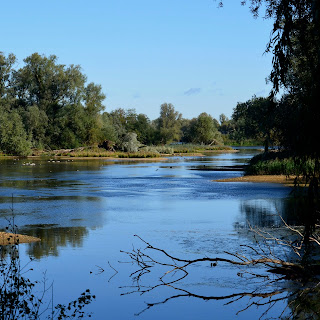
Even these islands were designed into the restoration.
Our objectives in terms of scenery or landscape are mixed. Along the river we have tried to restore the agricultural landscape that was there before quarrying, partly for nostalgic reasons but also in an effort to bring back lost arable weeds like corn-flower, corncockle and corn marigold as well as the summer songs of skylarks, turtle doves and yellowhammers. The rest of the Reserve is a mix of open gravels, quarry-ponds and patches of scrub, each with their own interest. We even try to preserve some of the features left behind by the quarry, in honour of all the people who worked here in the gravel industry over the last 80 years.

The next big design project is for our reedbed which will be excavated west of the Haul Road next to the quarry. This will take several years to establish but work could start in 2021.


The only place you can get a really good overview of the Reserve is from the top of Paxton Hill.


Thursday, 19 December 2019

Year's End

Another successful year for Huntingdonshire’s Countryside Service

The Christmas break is a good time to reflect on the past year and get ready for what the following year has to offer.  It is fair to say 2019 has been another busy year for Huntingdonshire District Council’s Countryside Service which looks after sites including Hinchingbrooke Country Park, Paxton Pits Nature Reserve, Barford Road Pocket Park, Holt Island Nature Reserve and the Huntingdonshire Community Plant and Tree Nursery. 

Volunteers have done a phenomenal amount of work totalling over 3,500 days over the year. 

Both Paxton Pits Nature Reserve and Hinchingbrooke Country Park received Green Flag Awards for a second year.  Hinchingbrooke also received the regional biodiversity award from Anglia in Bloom.

Paxton Pits
The Friends Groups for Hinchingbrooke, Paxton Pits and Holt Island continued to raise vital funds to support the work at the sites as well as organise work parties and events.

Wildlife is thriving in the area.  Highlights in 2019 include sightings at Paxton Pits of otters throughout the year including adults with young, and an abundance of dragonflies with a new record of Leaf Emerald Damselfly. At Hinchingbrooke Country Park wildlife highlights include Wasp Spiders and the damp autumn weather resulted in a wide variety of fungi.

One key attraction at Hinchingbrooke Country Park is the apiary run by Huntingdon Beekeepers where 18 hives can now be viewed - a major difference from the original 2 hives that were established in 1998.

Hinchingbrooke Country Park.
Hinchingbrooke and Barford Pocket Park in St. Neots host well supported Parkruns every Saturday morning.

Many well supported events have taken place around the Countryside sites in 2019, with more planned for 2020. A major expansion of Paxton Pits Nature Reserve is also being planned including the building of new bird hides and the creation of a large reedbed. 

With so much planned there will be lots of opportunities for people to get involved in the Countryside sites whether it be helping with the practical work, serving refreshments in our visitor centre, surveying and monitoring the wildlife or helping out at events.  If you are interested in volunteering please contact Volunteer Co-ordinator, Robyn Staddon via email Robyn.Staddon@huntingdonshire.gov.uk or pick up a volunteering leaflet at Hinchingbrooke Country Park or Paxton Pits Nature Reserve.  We would love to hear from you!
Further information about Countryside Services can be found in the parks and nature reserves section of Huntingdonshire District Council’s website, and Paxton Pits, Hinchingbrooke and Hot Island also have Facebook pages for up to date news and events information.
https://www.huntingdonshire.gov.uk/leisure/parks-nature-reserves-and-green-spaces/

Wednesday, 9 October 2019

The Coming of the Ice Birds

Trevor Gunton wrote this article for a local magazine.

From the breeding grounds in Greenland, Iceland, Siberia in the high Arctic and from Northern Europe come huge clanging battalions of geese, swans and wildfowl.  Did you know that over half a million wild geese overwinter in various areas of The British Isles ?
Paxton Pits Nature Reserve.

We humans may dread the onset of Winter, but to these long distance travellers our colder, grey and shorter days are a very welcome relief from the harsh conditions they would have had to face if they had stayed on their breeding grounds.

During the Summer, Veronica and I visited Svalbard, a series of remote Norwegian Islands, way above the Arctic Circle.  Here barnacle geese were still in family groups, feeding on the low lying land which surrounds the few human settlements. By the time you read this, all of the 40,000 plus population of this race of barnacle goose will have arrived back on their wintering grounds on the Solway Firth in southern Scotland – quite a remarkable journey !

Close to home, the Norfolk coast will host many thousands of dark bellied Brent geese, all the way from Siberia, along with a large percentage of Icelandic pink foot geese, making the UK one of the most important wintering areas for geese in Europe.
The viewing gallery at Welney Wash.

Here in the St Neots we are fortunate to live near to so many great areas for wintering wildfowl – such as the Fens, Nene and Ouse Washes, so close for local visits.

If you have never been to the fantastic Wildfowl and Wetland Centre situated at Welney, close to Ely, but actually just within Norfolk, promise yourself a visit this Winter.  There you can enjoy close views of a huge range of wintering wildfowl, especially the rare Whooper swans, all the way from Iceland.  The best part is the fact that viewing is from a range of birdwatching hides – the main observatory is even centrally heated – and you cannot get better than that can you ?  There is also a café and gift shop, making it the ideal day out in these colder days.

You do not even need to travel for excellent wildlife experiences this Winter.  Just around the corner you will find Paxton Pits Nature Reserve, owned by Huntingdon District Council and financially supported by The Friends of Paxton Pits Nature Reserve.  Each Winter We host over a dozen different species of wildfowl, and this year the wigeon duck arrived in late August, and will stay with us until it is time to return next Spring to its breeding grounds.  Paxton Pits can hold significant numbers of gadwall, mallard, shoveller, teal and tufted ducks, but numbers can fluctuate depending on the climate and water levels.

If the weather hardens, we can also expect to encounter such Arctic birds as the fish eating goosander and smew.  Don’t forget that we also have excellent birdwatching hides and a well-stocked information visitor centre and café.

By the way, please feed your garden birds, and keep the birds’ water supply free from ice – you really can make a huge difference to just how our local birds make it through the Winter.

Enjoy your wildlife watching this Winter, and if you can please visit us at Paxton Pits very soon – a warm welcome awaits !
Trevor Gunton for FPPNR, October 2019

Saturday, 21 September 2019

Go West Young Man

Sorry for the silence, Ive been away in Herefordshire for a family wedding.
Heaven for swallows and martins; plenty of food
and nest sites.
As we all know, the rapid decline in insect numbers in the UK and across the rest of Europe has had a serious effect on our insect-eating birds, but the effect is worst in lowland agricultural areas like ours. I witnessed this myself when I found house martins and swallows still raising young in in farms and villages along the Welsh border, long after the very few here in Brampton had given up and gone. More directly, I was struck by the sunlit swarms of insects at dusk under the trees, the moths that flew in and out of the house and spiders webs that festooned the branches on a dewy morning.
Clear air, rolling green hills with a
patchwork of woodland and ancient hedgerows.
Herefordshire always reminds me of Tolkein's Shire; small farms, small fields, livestock, orchards, hop-bines, mistletoe, endless dense hedges and lovely woods dot the rolling landscape. It hasn't changed much in my lifetime. Then there are the houses that dot the landscape or cluster into hamlets, mostly with plenty of nest sites for birds.
A West Country "motorway".
It's easy to imagine that the England that we have in our mind's eye might have been destroyed long ago while we were distracted by "progress" and shiny new tech, but it is still out there across big swathes of our country. Look for the older landscape West of the Great North Road in Northamptonshire, Leicestershire and all the way to Wales.
Of course we still have some treasures over here in the East but they are mostly isolated little gems, like islands in a sea of sugar beet, motorways and housing estates. How did this east-versus-west split come about?
Swarms of insects beneath the oaks.

The answers lie in geography, climate and human history.

I was thinking about these things as we drove home through Worcester, Stratford, Warwick to join the M6 and the A14. In Herefordshire the trees had been green, that grass was still growing and the air was fresh, but near Stratford the earth looked bit more brown and a bit less green. Some of the hedgerow trees were turning yellow and red. By the time we reached Coventry farms and roadside verges looked parched and dusty and autumn was creeping towards us from the East.

Rainfall is a big factor in the difference between East Anglia and the West Country. Most of our rain comes in from the Atlantic and Wales takes the dragon's share of it while the English lion gets what's left. It is simply that the lush landscape of Wales is hilly and lies upstream of us in terms of air currents.The parade of eastbound clouds often fizzles out before it reaches the flat-lands of Cambridgeshire. In fact, we get about the same amount of rain as falls in Jordan. That has a huge impact on agriculture, on vegetation and on insects and birds. Thats why the countryside here is so parched in comparison to the west.

We watched the traffic build up and the lanes multiply until I could stand it no more. I turned off the A14 at Naseby to find some country roads and immediately found a slice of proper landscape with stone houses, old walls and hedges, and a monument to the English Civil War battle that occurred there in 1645, which brings me to history.

The countryside landscape in the east is a modern one, created by enclosures and the draining of fenland. Fields are large and regular, like the whole landscape was drawn up on squared paper, which some of it was. Livestock farming is rare here and arable is king, and for that you need big fields t handle big harvesting equipment. You also need tonnes of chemicals to keep taking big yields off the same fields year after year. When the fields were enclosed, over two hundred years ago, mist of the blackthorn to hedge the east midlands was grown here in Brampton and Buckden. They didn't bother with hedges much in the Fens.

Straight fields, straight ditches and straight roads are a feature of our flat landscape so there are no surprises round the corner. In the old landscape the field patterns were based on Norman practices, with three large fields surrounding the village with its manor, church and tythe barn. Sometimes the road wound its way round the fields and through the village following old desire lines or even he whim of a badger who walked there first. The pattern would be disrupted by groves of trees and meandering rivers. And that's how most of England still looks if we get off the dual carriageway and head for the hills.


Swallows nesting in a porch on September 16th.
Young one on the left.
Looking for the vanished wildlife of Olde England? "Go West Young Man", I say.

Tuesday, 3 September 2019

A day out at Minsmere

The RSPB's showcase reserve at Minsmere is a sacred place for birdwatchers and rightly so. That's why we chose to spend our 36th wedding anniversary there rather than boring old Biarritz.


After a friendly greeting and very detailed briefing from the reception volunteer, we had a bite of lunch outside near the now abandoned sand martin cliff.  Our circular walk started out a bit slow for us, yielding only garden birds and a lesser whitethroat, but then we hit the beach.

The dense gorse, elderberry, bramble and sea buckthorn along the dune-crest came alive with small birds. One scrappy elder held two stonechats and three whitethroats while a clump of bramble held a starling, more whitethroats, a garden warbler, another stonechat and a whinchat. A Dartford warbler sat out on a sprig of honeysuckle and two more skulked in the gorse where they had nested a couple of months ago.

The heart of the Reserve is the scrape, which was rather quiet with all of the breeding birds gone, but quiet for the scrape would be brilliant everywhere else.

Our bird-list included black-tailed and bar-tailed godwits, snipe, wood, green and common sandpipers, ringed and golden plovers, avocets, grey herons, dunlin, redshank, green- shank, water rail, moorhen, little grebe, shoveler, gadwall, mallard, teal, widgeon, greylag and Canada geese.

Out in the fields the Konig horses and beef cattle were joined by little and cattle egrets while a grey and gold male marsh harrier circled over-head on long up-tiled wings. Not a bad list, I'd say, and that's omitting all the tits, robins, dunnocks, finches and gulls. Then there's the invertebrates too.

As the late summer sun started to descend, rabbits sunned themselves on the sand, a red deer munched blissfully away in the reed-bed, ten feet off the path, then a casual red fox slunk across the road on our way out towards our supper at the famous and ridiculously named Eel's Foot Inn.

Friday, 30 August 2019

Three more things to worry about

If you keep up with the national news you will already have enough to worry about; … the list gets longer every day. Depressing isn’t it? You might want to take a walk around the nature reserve to calm your nerves. It always works for me. But, before you put on your boots, let me give you three more things to worry about; Weil's disease, blue-green algae and Lyme disease.


Taking a walk in the countryside or anywhere else presents a few hazards but we take pride in offering a place that is safe for people and wildlife. I would argue that it would be hard to find anywhere more safe than Paxton Pits, but it is always better to be informed than ignorant regarding safety issues.

This summer both blue-green algae and Weil’s disease have have hit the national headlines.  The hot and dry weather led to low pond levels and the lakes turned to warm soup: perfect conditions for algae and bacteria to thrive. The same conditions attracted a lot of people to go wild swimming and some of them caught Weil’s disease as a result.

1              Weil’s disease (also known as leptospirosis) is a serious infection that is spread in the urine of infected animals such as rats, mice and dogs that urinate on the bank or in the water. You can be infected if you go into the water and you have a cut or abrasion, or the water gets into your mouth. If you are an angler or you are pond dipping, wash your hands frequently (wet-wipes are good for this). As far as we know, we have never had a case at Paxton Pits…..but this year we have.
The pond looks inviting; but it's not safe to swim in.

2              Blue-green algae appears increasingly every summer in almost all lakes. It floats to the surface where wave-action drives it to bays where it accumulates in a rotting, toxic, turquoise heap. Sadly, these are just the places where people let their pets into the water. Dogs then lick themselves and often die as a result. Many dog owners have no idea of the danger, and only find out from their vet when it’s too late. Again, this isn’t a drill; it’s been happening.
"A warm, green soup" with a frog in it.

3              We are all aware of nettles, thistle, bees, wasps, horse flies, mosquitos and other minor irritations, but what about ticks? Lyme disease is another really serious illness that we need to inform ourselves about and it is spread by deer ticks. We used to think that Muntjac (the little deer that we have at Paxton Pits) did not carry the disease, but now we know that they do and there have been cases locally in woodland but not on the Reserve. If you stay on the paths you are not likely to pick up any ticks but brushing against the vegetation, such as when blackberry picking, makes you more vulnerable. It is sensible to wear long trousers and tuck them into your socks. If you do pick up a tick, look up how to remove it or you will end up with the head still embedded in your skin. If you have a bite that has a red “bullseye” ring around it, see your GP as soon as possible.

Muntjac deer

None of this should put you off going for a walk but please check the NHS website to learn more about the risks and symptoms for Weil’s and Lyme diseases. My best advice stay on the paths and don’t swim in the lakes. 

Now for that walk. Autumn migration will bring in many more birds; some passing through and others staying the winter. Icelandic waders and ducks started to arrive in August. I’m looking forward to seeing late summer butterflies and spooky looking fungi through the next month.

Ranger Jim

Wednesday, 31 July 2019

Meeting "Big Bill"


Trevor Gunton sent us this article that he has written for "The Villager" magazine.

Great white egret meets a bittern on Weedy Pit.

My initial interest in the heron family of birds began many years ago in Yorkshire, both during and after the harsh 1962/3 Winter, one of the longest and coldest for about 100 years.  Bird populations crashed and even Bridlington Bay froze !  My survey of Yorkshire herons showed that at all sites numbers of breeding herons dropped dramatically, whilst some sites were abandoned and never to be reoccupied.  In contrast to this, last year’s “Beast from the East” had no detrimental effect on heron numbers across the UK.  During my time in Yorkshire I also studied heron standing grounds, usually situated on ploughed land close to the breeding site.  Traditionally, it was thought that these gatherings were used by young birds getting to know about local conditions, and possible breeding partners.  Little is known about this aspect of the heron’s lifestyle – and regretfully I had to end this work when we moved to Little Paxton in 1968.

Fortunately, my new home had a gravel pit heronry site on the edge of the village – amazing good luck for me !  In the early days this site held 25 nests in 1989, only to fall away to just single figures in recent years.  The reason for the decline at Paxton Pits is unknown, but it is known that there are a number of new sites – sometimes just 2/3 pairs have been established in the Fens.

Around St Neots, historically, there were breeding sites in Priory Park and Hemingford Park – but these have long since been abandoned.  Do cormorants have a detrimental effect on breeding herons ?  We do not know the answer to this.  In hard Winters, the cormorant numbers have been huge, peaking at 880 in January 1994, very much reduced in recent years.

Great white egret producing a pellet.
These are exciting times for heron enthusiasts locally as new species move in to enliven the birdwatching scene.  The attractive little egret has been around for over 20 years as a new breeding resident.  They have bred in the UK for nearly 30 years – along the South Coast, Wales, Kent and East Anglia.  Here at Little Paxton Nature Reserve we have seen them displaying and carrying sticks into the heronry area – but still no sign of nesting.  We wonder why ?

Last year we had another surprise when the larger relative of the little egret arrived at Paxton – this is in the form of the amazing great white egret – a previously very rare visitor from Europe.  They also have bred recently in East Anglia – so why not with us ?

Veronica and I have recently had a birdwatching holiday in Somerset where we found the great white egret more common than the little egret – also no less than 45 booming bitterns. Night heron and little bittern were also present on the Somerset Levels this year.

Back to Paxton- with the coming of Autumn be on the watch for our glorious white herons.  Last Autumn we recorded no less than 30 little egrets and 7 great white egrets on the same day.  Others to look out for are the cattle egrets – another invader from Southern Europe – now wintering and breeding in Southern Britain.  Bitterns also sometimes winter at Paxton Pits, so the prospects look good for the future, with lots more local wetlands being created in the Ouse and Nene valleys.
So, why go to Norfolk ?  Come to Paxton Pits this Autumn – you might be very surprised – and pleased by what you see !
TG July 2019